Menopause and Hearing Loss: Is There a Connection?
You may expect hot flashes or differences in sleep during menopause. But
Now part of the Beltone Hearing Care Network, visit www.beltonesound.com for a complete listing of all locations in the US



You may expect hot flashes or differences in sleep during menopause. But what happens when conversations also seem harder to follow?
Perhaps you hear someone speaking but miss a few words. Dinner with friends takes more effort than it used to. You find yourself asking, “What was that?” more often, even when the person is sitting nearby.
It is reasonable to wonder whether these changes are connected.
Hearing health deserves attention during the menopausal transition. Research has documented hearing changes across this stage of life, with hormones, aging, and metabolic health all under investigation. Menopause alone does not explain every hearing change, and those changes should not be ignored as something you simply “have to live with.”
Difficulty following conversations, frequent requests for repetition, or trouble hearing in background noise are reasons to schedule a hearing evaluation. Recognizing these signs gives you a clear starting point for understanding your hearing and finding the right support.
Hearing depends on more than your ears alone. Your inner ear, nerves, and brain work together to help you detect sound and understand speech.
Estrogen plays a role in this system. That has led researchers to explore whether changes in hormone levels during menopause may affect hearing.
However, this connection is difficult to study. Hormone changes happen during a stage of life when other factors can also influence hearing. Years of noise exposure, age-related changes, certain medications, and health conditions may all be part of the picture.
In other words, hearing changes that happen during menopause are not necessarily caused by menopause. A hearing evaluation can help you understand your hearing rather than leave you guessing.
Recent studies offer useful clues, but they do not give us one simple answer.
A study published in Maturitas followed 4,448 women and examined hearing changes across the menopausal transition. Researchers found that hearing declined after the final menstrual period. They also identified different patterns of change. The group with poorer starting hearing and a steeper decline had higher rates of excess weight and elevated blood sugar.
A separate U.S. study examined hearing and reproductive health in 1,778 women. After accounting for age and other factors, researchers found no significant link between being postmenopausal and hearing loss. However, later menopause and a longer reproductive lifespan were associated with better hearing.
These findings suggest that reproductive health and hearing may be connected in complex ways. They do not prove that changing hormones cause hearing loss—or that every woman will experience hearing changes during menopause.
For now, the practical message is straightforward: include hearing in your midlife health conversations, especially if something feels different.
Hearing loss does not always begin with sounds becoming quieter. Sometimes, the first change is that speech seems less clear.
You may notice that you:
These experiences can have several causes. They are not a checklist for menopause-related hearing loss. However, they are good reasons to have your hearing checked.
Try to notice when the difficulty happens. Is it mostly in noisy places? Does one ear seem different from the other? Did the change happen gradually?
Sharing those details helps your hearing care provider understand what you are experiencing.

Some women also have questions about tinnitus during midlife. Tinnitus is the perception of sound, such as ringing or buzzing, when there is no outside source.
Tinnitus and hearing loss are related concerns, but they are not the same thing. Ringing in your ears does not tell you your hearing levels or what is causing the sound.
If ringing is new, persistent, or affecting your daily life, bring it up with your hearing healthcare provider. You can also read our article on tinnitus and menopause for a closer look at that topic.
Hormone therapy is used to manage certain menopause symptoms. However, it should not be viewed as a treatment for hearing loss.
The U.S. study described above found no significant association between hormone therapy use and hearing loss. That finding does not establish a hearing benefit from treatment.
Decisions about hormone therapy belong in a conversation with the clinician managing your menopause care. Do not start, stop, or change a prescription based on hearing concerns alone.
If you notice changes in hearing, tell that clinician and arrange a hearing evaluation. Looking at both concerns gives your providers a clearer picture.
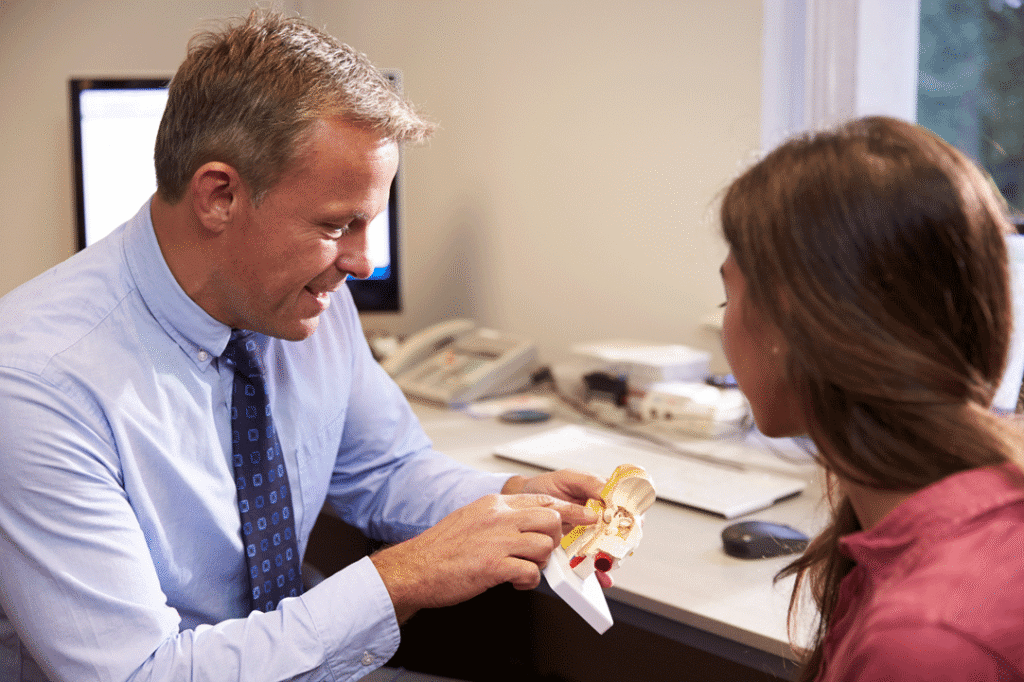
If hearing is making everyday conversations harder, it is worth scheduling an appointment. You do not have to wait until you are missing most of what people say.
An audiologist can assess the type and degree of hearing loss and discuss what the findings mean for your daily life. Be ready to share your health history, medications, noise exposure, and the situations where listening feels difficult.
Your results can guide the next step. Depending on your needs, that may include communication strategies, hearing technology, or a recommendation for further medical care.
Sudden hearing loss needs immediate medical attention. If hearing drops all at once or over a few days, seek medical care right away. Do not assume it is a hormone change or wait for a routine hearing appointment.
While you are arranging care, a few changes may make listening more comfortable.
Turn down the television or music before starting a conversation. Sit where you can see the other person’s face. At restaurants, choose a quieter table away from speakers and busy walkways.
If you miss something, ask for it to be said another way. A different word or shorter sentence may be easier to follow than the same sentence repeated louder.
Letting others know what helps can make conversations easier for everyone. You do not need to pretend you heard something just to keep the conversation moving.
Midlife can bring plenty of questions about your health. Hearing deserves a place in that conversation, even while researchers continue to study its relationship with menopause.
You do not need to decide whether hormones, age, or something else is responsible. Start with what you notice and how it affects your day.
At Salem Audiology Clinic, we take time to listen to those concerns, explain your results, and help you understand your options. Our goal is to help you stay involved in the conversations and activities you enjoy.
If you have noticed a change, contact Salem Audiology Clinic to schedule a hearing evaluation. We are here to help you take the next step with confidence.
Menopause and Hearing Loss: Is There a Connection?
You may expect hot flashes or differences in sleep during menopause. But

AI Hearing Aids: What Does Artificial Intelligence Actually Do for Your

Community Hearing Loss Tinnitus
Every day, millions of Americans rely on medications to fight infections,
Testimonials
For more than 40 years, families across the Willamette Valley have trusted Salem Audiology Clinic with their hearing care. Here’s what some of our patients have shared about their experience with us: